
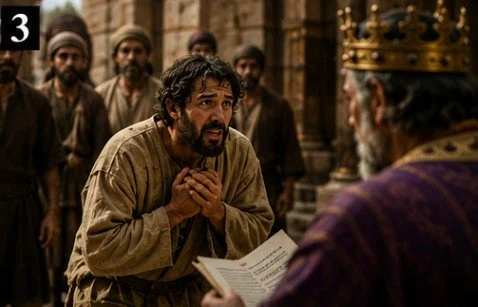
Parable of the Unforgiving Servant
Leader’s Guide
Quick links in this study:
Provide some historical background before starting the study.
Leader to read: Jewish teachers generally understood that forgiveness should be extended repeatedly, but many associated the limit with three offenses. This understanding was often connected with God's repeated judgments in the opening chapters of Amos (e.g., Amos 1–2),[1] where the phrase "for three transgressions...and for four" was interpreted by some as illustrating God's patience before judgment.
That idea never turned into any official rule capping forgiveness at three times, but it still shaped how most Jews thought about it day to day. That’s why Peter’s offer of seven times came across as pretty generous.
How Much Should We Forgive?
(Have someone read the verses outlined in Matthew 18:21—22.)
21 Then Peter came to Him and said, “Lord, how often shall my brother sin against me, and I forgive him? Up to seven times?” 22 Jesus said to him, “I do not say to you, up to seven times, but up to seventy times seven.
1. What prompted Peter to ask Jesus about forgiveness?
Peter asked right after Jesus taught about confronting a brother who sins against you. He got that forgiveness was necessary, but he still wanted to know if there was a limit.
2. Why did Peter suggest forgiving someone seven times?
Peter apparently considered seven times to be a generous and complete amount of forgiveness. The study summary explains that some Jewish thinking associated forgiveness with a much smaller number, so Peter's suggestion sounded very generous. Also see Amos 1—2.
3. What assumptions were behind Peter’s question?
Peter assumed that forgiveness could be measured and eventually exhausted. His question was essentially, “How many times do I have to forgive before I have forgiven enough?”
4. What did Jesus mean by “seventy times seven”?
Jesus was not establishing a mathematical limit of 490 acts of forgiveness. He was removing the idea that forgiveness should be calculated numerically.
5. Why is Matthew 18:22 important to Christian discipleship?
Jesus presents forgiveness as a defining characteristic of His followers. Forgiveness is not merely something Christians do occasionally; it should become part of the believer’s character.
Understanding the Enormous Debt
Leader information: Jesus now moves from the question of “How many times?” to the much deeper question of “Why should we forgive?” The word “therefore” connects the parable directly to Jesus’ teaching about unlimited forgiveness.
(Have someone read the verses outlined in Matthew 18:23—25.)
23 Therefore the kingdom of heaven is like a certain king who wanted to settle accounts with his servants. 24 And when he had begun to settle accounts, one was brought to him who owed him ten thousand talents. 25 But as he was not able to pay, his master commanded that he be sold, with his wife and children and all that he had, and that payment be made.
6. Why does Jesus begin the parable with the word “therefore”?
“Therefore” connects the parable to Jesus’ teaching about forgiveness. Jesus is about to explain why His disciples should forgive others.
7. Who does the king most likely represent?
The king most likely represents God the Father. Although some commentators see a possible connection to Christ, the context favors God the Father as the eternal King. Some related passages: Psalm 47:7-8; Matthew 6:9.
8. What does the servant’s enormous debt represent?
The enormous debt represents the immeasurable debt of sin that humanity owes to God.
9. Why did Jesus describe the debt as “ten thousand talents?”
Jesus used an intentionally enormous amount to communicate that the debt was beyond the servant’s ability to repay. Ten thousand was the largest commonly used Greek number, while a talent was the largest monetary unit.
10. What does the servant’s inability to pay teach us about humanity’s condition before God?
It illustrates that sinners cannot satisfy their debt to God through their own efforts. Human righteousness and good works cannot erase the debt of sin—Supporting verse: Romans 3:23.
11. Why did the king order the servant and his family and possessions to be sold?
The action illustrates the seriousness of the servant’s debt and the consequences of being unable to satisfy the king’s demands.
Receiving and Extending God’s Mercy
Leader information: God's mercy is not meant to stop with us—it is meant to flow through us to others. A person who truly understands the magnitude of God's forgiveness should increasingly become willing to forgive.
(Have someone read the verses outlined in Matthew 18:26—30.)
26 The servant therefore fell down before him, saying, ‘Master, have patience with me, and I will pay you all.’ 27 Then the master of that servant was moved with compassion, released him, and forgave him the debt. 28 “But that servant went out and found one of his fellow servants who owed him a hundred denarii; and he laid hands on him and took him by the throat, saying, ‘Pay me what you owe!’ 29 So his fellow servant fell down at his feet and begged him, saying, ‘Have patience with me, and I will pay you all.’ 30 And he would not, but went and threw him into prison till he should pay the debt.
12. What did the servant do when he realized he could not pay?
He fell before the king and pleaded for patience, promising to repay the debt.
13. Could the servant actually repay his enormous debt?
No. The debt was beyond his ability to repay. His promise to repay everything demonstrates that he did not understand the true magnitude of his situation.
14. What did the king do that the servant did not deserve?
The king had compassion and completely canceled the servant’s enormous debt rather than merely giving him additional time.
15. What does the cancellation of the debt represent?
It represents God’s merciful forgiveness of sinners.
16. Why is the servant’s treatment of his fellow servant so shocking?
Immediately after receiving extraordinary mercy, the servant demanded payment from someone who owed him a much smaller amount.
17. Does the smaller debt mean that offenses against us are unimportant?
No. The study specifically emphasizes that 100 denarii was a significant amount in everyday life. Jesus was not saying that human offenses are meaningless. He was contrasting them with the immeasurable debt that God forgives.
The Heart of a Forgiving Person
Leader information: The final section reveals that the central issue is not merely whether the servant forgave, but whether the mercy he had received had actually transformed his heart.
(Have someone read the verses outlined in Matthew 18:31—35.)
31 So when his fellow servants saw what had been done, they were very grieved, and came and told their master all that had been done. 32 Then his master, after he had called him, said to him, ‘You wicked servant! I forgave you all that debt because you begged me. 33 Should you not also have had compassion on your fellow servant, just as I had pity on you?’ 34 And his master was angry, and delivered him to the torturers until he should pay all that was due to him.
35 “So My heavenly Father also will do to you if each of you, from his heart, does not forgive his brother his trespasses.”
18. What does the servant’s refusal to forgive reveal about his heart?
It reveals that although he had received extraordinary mercy, he had not allowed it to change how he treated others.
19. What does Jesus mean by forgiving “from your hearts”?
Real forgiveness has to come from the heart—not just words or going through the motions. Barnes says it means actually releasing the resentment, not just claiming you’ve forgiven someone.
20. What is the central lesson of the entire passage?
Those who have received God's immeasurable mercy should become people who extend mercy to others. Our debt to God is immeasurably greater than the debts others owe us, and refusing to forgive reveals an unmerciful heart. Core principle: Forgiven people should become forgiving people.
[1] Radmacher, Earl D., et al. NKJV Study Bible. Thomas Nelson, 2018, pp. 1298-1300.