
Parable of the Unforgiving Servant
In-Depth Summary
Quick links in this study:
The in-depth summary of each bible study is much different from the small group bible study laid out before the leader and the students. The small group studies are intended to be interactive, provide a learning atmosphere for students, and open discussions allowing for interpretations of what the gospels’ witnessed. The in-depth summary is designed to help the leader with expansive information, much more than what is in the text notes found at the bottom of every bible page. An exhaustive search was completed on each verse to help the Leader answer questions that may come up during the study.
Historical Background: Jewish teachers generally understood that forgiveness should be extended repeatedly, but many associated the limit with three offenses. This understanding was often connected with God's repeated judgments in the opening chapters of Amos (e.g., Amos 1–2),[1] where the phrase "for three transgressions...and for four" was interpreted by some as illustrating God's patience before judgment.
Even though that view never became an official rule limiting forgiveness to three times, it still colored everyday Jewish thinking. So when Peter suggested seven times, it actually sounded pretty generous.
How Much Should We Forgive?
Matthew 18:21-22
Matthew 18:21: Matthew 18:21 sits right between Jesus’ teaching on how to handle a sinning brother (verses 15-20)[2] and the parable of the unforgiving servant that follows (verses 23–35).[3] Peter’s first question already shows he’s grown. He doesn’t ask if he should forgive a repentant brother, he knows that’s the right thing to do. Barnes points out that this question comes directly from what Jesus said in verse Matthew 18:15[4] about dealing with someone who has offended you. But the second part of Peter’s question still assumes forgiveness has a limit, as if mercy can be measured out and eventually used up. Ellicott suggests Peter probably thought seven times was a generous and complete number.[5]
Matthew 18:22: Jesus gently corrects Peter. Peter's question assumed that forgiveness has measurable boundaries. By answering "seventy times seven," Jesus is not prescribing 490 acts of forgiveness but abolishing numerical calculations altogether. The pulpit commentary provides the broadest theological reflection: There is no measure to forgiveness; this captures the central message of the verse. The pulpit commentary moves beyond numerical discussion to explore the redemptive significance of forgiveness in the gospel.[6] The verse establishes forgiveness as a defining characteristic of Christian discipleship and prepares for the Parable of the Unforgiving Servant
Understanding the Enormous Debt
Matthew 18:23-25
Matthew 18:23: The "therefore" links the parable directly to Jesus' teaching on limitless forgiveness, showing that God's forgiveness of sinners is the foundation for believers’ forgiveness of one another. The king in Jesus' parable (Matthew 18:23) represents God. Some commentators suggest that the king could symbolize Christ, the Messiah, King of kings, and ruler over His people. As God, Christ reigns over all creation, and as Mediator He rules in the kingdom of grace. However, the commentary concludes that the king is more likely to represent God the Father because He is the eternal King whose authority extends over nature, grace, and glory.[7] The parable teaches that every believer stands before God as a debtor entirely dependent upon divine mercy. God makes a man turn his eyes inward and learn how he stands in the sight of his Lord.6 Only when a person understands the magnitude of God's forgiveness toward them can they properly extend forgiveness to others.
Matthew 18:24: John Gill, an 1800’s English Baptist pastor and theologian, provides an excellent summary of this verse. The king in Jesus' parable primarily represents God the Father, though some commentators suggest He may also point to Christ, the King of kings and Lord of lords. The context favors God the Father, who reigns sovereignly over His kingdom of nature, grace, and glory and will one day call every person to give an account. When the king settles accounts with his servants, one servant owes him ten thousand talents—an unimaginably large debt. In Jesus' day, ten thousand was the largest number commonly used in Greek, and a talent was the largest monetary unit. Together they portray an incalculable debt that could never realistically be repaid. The amount is intentionally exaggerated to illustrate the immeasurable debt of sin that humanity owes to God.[8]
Matthew 18:25: The servant's enormous debt as a picture of humanity's spiritual debt caused by sin. The "ten thousand talents" represent the overwhelming guilt of sin and humankind's inability to make restitution before a holy God. Every sinner stands unable to repay what is owed to God because sin creates a debt that is beyond human ability to satisfy. Human efforts, good works, or personal righteousness cannot meet the demands of divine justice because obedience is already humanity's obligation to God. Jesus Christ, as the believer's substitute and redeemer, paid the debt of sin through His blood and righteousness, accomplishing what humanity could never do.9
Receiving and Extending God’s Mercy | Matthew 18:26-30
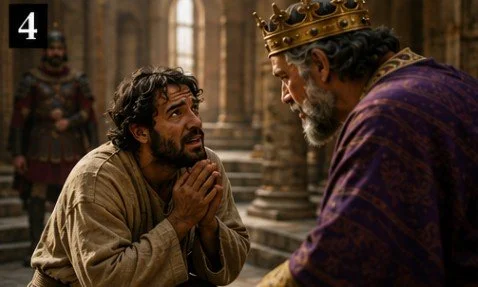
Matthew 18:26: John Gill sees the servant’s reaction as a picture of the sinner who finally faces the weight of his sin and God’s justice. Falling down before the king, the man admits his guilt and knows he is helpless—he simply cannot pay what he owes. When he begs for more time, he asks for mercy and a stay of judgment. Yet his promise, “I will pay thee all,” shows the old mistake of thinking that harder work, better behavior, or personal goodness can somehow settle the account. Gill is clear: that is impossible. Sin leaves a debt before God that no human effort can clear. Forgiveness is never something we earn; it comes only from God’s own compassion. In the end, only divine grace—given through Christ’s perfect righteousness and sacrifice—can wipe the debt away and bring real forgiveness.9
Matthew 18:27: Matthew 18:27 marks the real turning point in the parable of the unforgiving servant. Once the man admits he is helpless and begs for mercy, the king answers with surprising kindness. He doesn’t just give him more time—he completely wipes out a debt the servant could never have paid. Jesus paints this picture to show how freely God pours out mercy on people who turn to him in repentance. The forgiveness comes purely from the king’s compassion, not from anything the servant could ever do to settle the account.
Albert Barnes provides the strongest interpretation of this verse itself because he remains closest to Jesus' purpose in the parable. He correctly identifies the king as representing God's mercy, explains the servant's impossible debt, and wisely cautions against assigning doctrinal meaning to every detail. This reflects sound principles for interpreting parables, where the central lesson should remain primary.[9] This verse stands as one of the clearest pictures in the Gospels of the immeasurable grace God freely gives to those who come to Him in humble repentance.
Matthew 18:28: Matthew 18:28 shows the jarring contradiction of someone who has just received God’s mercy yet refuses to pass it on. Right after being forgiven a debt he could never repay, the servant goes looking for a fellow servant who owes him only a small amount. Instead of treating him with the same kindness he himself had just been shown, he seizes the man and demands payment. Jesus deliberately sets the king’s enormous forgiveness beside this tiny debt so we will see that the wrongs done to us—real and painful as they may be—are nothing compared with the debt we ourselves owe God.
The observation that the meeting with the fellow servant was a providential test of whether mercy had transformed the forgiven servant's heart is especially compelling. The simple statement, "He remembers this fact; he forgets his late experience," summarizes the tragedy of the verse and explains why the servant's behavior is so reprehensible. Pulpit also maintains the proper focus on the disparity between sins against God and offenses against fellow humans, without straying too far from the text.
Matthew 18:29: Charles Ellicott notes that 100 denarii was a significant sum in everyday life. This protects readers from thinking Jesus is minimizing real injuries. Instead, Jesus teaches that even substantial wrongs against us are small compared with the immeasurable debt God has forgiven.5 Matthew 18:28 shows what was really going on in the forgiven servant’s heart. Even though his master had just poured out extraordinary mercy on him, that mercy never changed the way he treated other people. Instead of passing on the grace he had received, he grabbed a fellow servant who owed him only a small amount and demanded payment by force. Jesus is making it plain that anyone who has tasted God’s immeasurable forgiveness should become a forgiving person themselves. The huge difference between the two debts doesn’t mean the hurts we suffer from others aren’t real. It simply reminds us that every offense against us is tiny next to the forgiveness God has already given us. Real gratitude for that mercy shows up when we turn around and show the same mercy to others.
Matthew 18:30: Matthew 18:30 exposes the tragic inconsistency of a person who has received great mercy but refuses to show mercy to others. The unforgiving servant rejects his fellow servant's plea, refuses even a short delay, and has him imprisoned. His actions are not only cruel but irrational, since imprisonment makes repayment impossible. Its central insight is that the servant ignored the very mercy that had just rescued him. The servant's conduct is so shocking. He forgot the words that had secured his own deliverance and allowed greed, cruelty, and revenge to govern his actions. Jesus teaches that those who have experienced God's immeasurable forgiveness should become people marked by patience, compassion, and forgiveness. A heart transformed by grace will extend grace, while a heart ruled by bitterness forgets the mercy it has received.
The Heart of a Forgiving Person
Matthew 18:31-35
Matthew 18:31: Matthew 18:31 marks the turning point of the parable. The unforgiving servant's cruelty does not go unnoticed. His fellow servants are deeply grieved by his lack of mercy and report the matter to their master. Their response demonstrates that unforgiveness damages not only the offender and the offended but also the entire community. The fellow servants were "very sorry," not primarily angry. This reflects the heart of Christ's disciples, who grieve over sin because it damages relationships within God's family. Sorrow, rather than anger, is the mood of the true disciple of Christ.5
Matthew 18:32: Matthew 18:32 opens the king’s judgment of the unforgiving servant. He doesn’t confront the man for the huge debt he once owed; he confronts him for refusing to show the same mercy he had just been given. The king now calls him “wicked” because his actions prove that compassion never really touched his heart. Being unmerciful is no small fault—the servant deserves that hard word because his refusal of mercy is as serious as theft or murder. The king then sets the two sides side by side: the extravagant mercy he himself had received, and the harshness he turned around and showed. He reminds the servant that canceling that massive debt went far beyond anything the man had even asked for. Jesus’ point is clear: anyone who has received God’s forgiveness is expected to pass that same mercy on to others. When we don’t, it lays bare just how hard and unmerciful our hearts really are.
Matthew 18:33: The servant's greatest sin was not merely that he refused to forgive; it was that he refused to forgive after he himself had experienced extraordinary forgiveness. The servant's actions revealed that he did not truly understand or appreciate the mercy he had received. This verse teaches that God's forgiveness is not meant to stop with us—it is meant to flow through us to others. Cross-reference this verse with Matthew 6:12 from the Lord’s Prayer: “And forgive us our debts, as we forgive our debtors.”[10]
Matthew 18:34: God's anger is different from human anger; it is righteous judgment. The servant's punishment was not because he had once been forgiven and then made a simple mistake. His refusal to forgive revealed that he had never truly understood the mercy or grace he received. Refusing mercy reveals a heart unchanged by God's mercy.
The verse teaches that a person who has genuinely experienced God's forgiveness will become forgiving toward others. Jesus states this again after the Lord’s prayer in Matthew 6:14-15: “For if you forgive men their trespasses, your heavenly Father will also forgive you. But if you do not forgive men their trespasses, neither will your Father forgive your trespasses.”10
Matthew 18:35: The message is clear: God has forgiven us an immeasurable debt; therefore, we must forgive the much smaller debts others owe us. The person who refuses to forgive others demonstrates that he has failed to understand the mercy he himself received. Barnes explains the phrase “from your hearts” means that forgiveness must be genuine and sincere, not just words spoken outwardly. True forgiveness involves letting go of resentment and treating the offender with the same mercy God has shown to us.
Summary:
1. Our sins against God are great — We owe God a debt we could never repay.
2. God freely forgives us — He shows mercy and cancels our debt.
3. The offenses others commit against us are small in comparison — The wrongs done to us are minor compared with what God has forgiven us.
4. We should therefore freely forgive others — Since we have received mercy, we should show mercy.
5. A refusal to forgive brings God's judgment — Those who refuse to forgive demonstrate an unmerciful heart and should not expect to receive God's forgiveness.[11]
Parable interpretations:
· The King = God
· The forgiven servant = Us as sinners who receive God's mercy
· The huge debt = Our sin before God
· The cancellation of debt = God's forgiveness
· The fellow servant = Those who wrong us
· The smaller debt = Their offenses against us
· The unforgiving servant = A person who receives mercy but refuses to give mercy
· The tormentors = God's righteous judgment
· The lesson = Forgiven people should become forgiving people
The greatest failure of the unforgiving servant was not simply that he refused to forgive—it was that he received extraordinary mercy but allowed that mercy to have no effect on his own heart.
[1] Radmacher, Earl D., et al. NKJV Study Bible. Thomas Nelson, 2018, pp. 1298-1300.
[2] Radmacher, Earl D., et al. NKJV Study Bible. Thomas Nelson, 2018, p. 1436.
[3] Radmacher, Earl D., et al. NKJV Study Bible. Thomas Nelson, 2018, p. 1437
[4] Barnes, Albert, and Robert Frew. Notes on the New Testament : Matthew and Mark. Grand Rapids, Mich., Baker Book House, 1985. pp. 188-189.
[5] “Matthew 18 Ellicott’s Commentary for English Readers.” Biblehub.Com, https://biblehub.com/commentaries/ellicott/matthew/18.htm. Accessed 20 July 2026. Matthew 18:21
[6] “Matthew 18 Pulpit Commentary.” Biblehub.Com, 2026, https://biblehub.com/commentaries/pulpit/matthew/18.htm. Accessed 21 July 2026. Matthew 18:22.
[7] “Matthew 18 Gill’s Exposition.” Biblehub.Com, 2026, https://biblehub.com/commentaries/gill/matthew/18.htm. Accessed 21 July 2026. Matthew 18:23.
[8] Gill, John. “Matthew 18 Gill’s Exposition.” Biblehub.Com, 2026, https://biblehub.com/commentaries/gill/matthew/18.htm. Accessed 21 July 2026.
[9] Barnes, Albert, and Robert Frew. Notes on the New Testament : Matthew and Mark. Grand Rapids, Mich., Baker Book House, 1985. pp. 189-190.
[10] Radmacher, Earl D., et al. NKJV Study Bible. Thomas Nelson, 2018, p. 1418.
[11] Barnes, Albert, and Robert Frew. Notes on the New Testament : Matthew and Mark. Grand Rapids, Mich., Baker Book House, 1985. p. 191.