
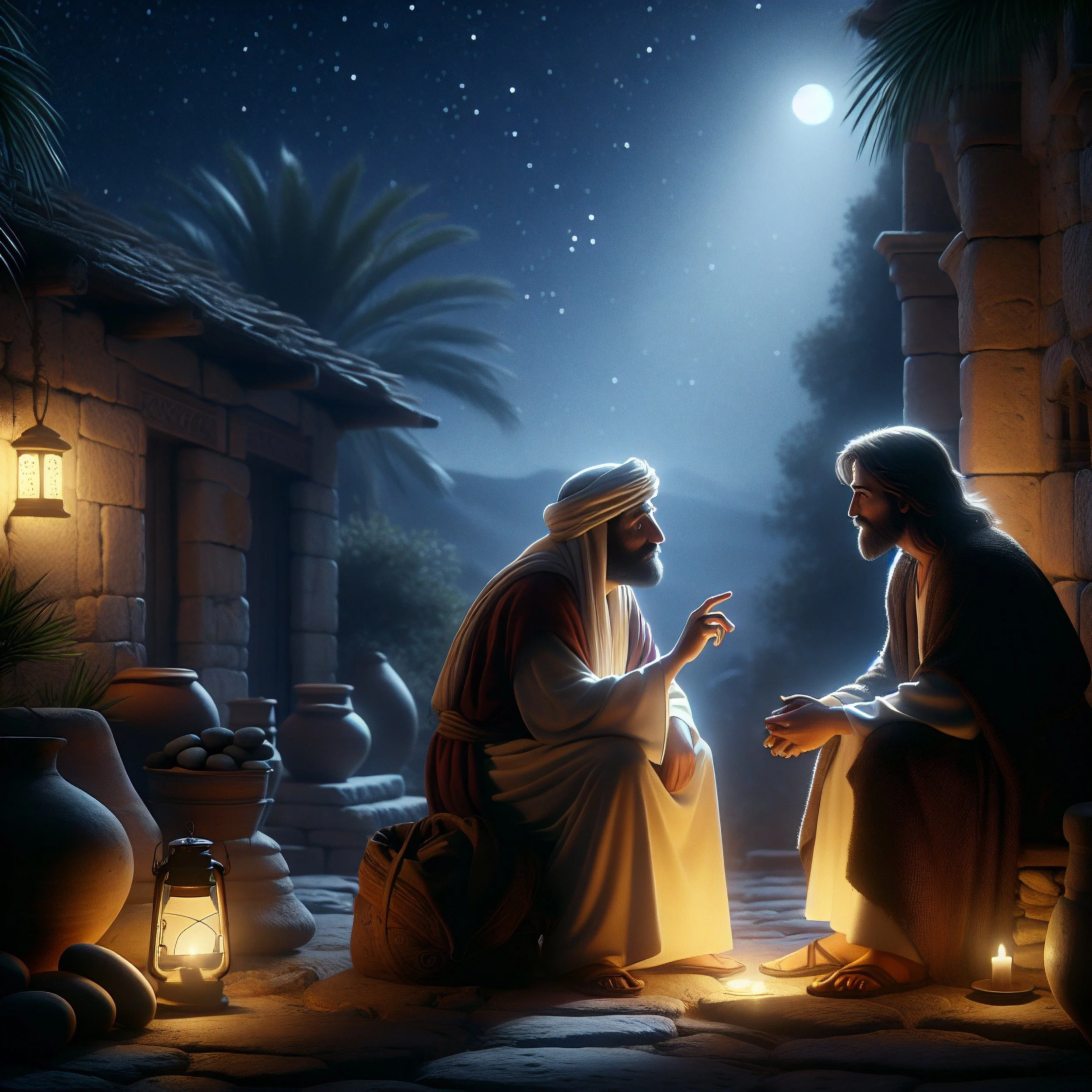
Jesus Discourse with Nicodemus
In-Depth Summary
Quick links in this study:
This is one of the most impactful chapters in the book John’s book. John records a private theological conversation between Jesus and Nicodemus, a Pharisee and a member of the Sanhedrin. This study also contains the most recognizable verse in the entire Bible, John 3:16.
Nicodemus Comes to Jesus (John 3:1-2)
John 3:1: Nicodemus was a prominent, respected Jewish leader belonging to an influential Jewish sect known as the Pharisees. The Pharisees were members of a religious party in Palestine from 515 BC to AD 70. They insisted on oral tradition, called the unwritten or Oral Torah. They had a reputation for strictly observing the rites and ceremonies of the written law. Mostly, they wanted to be seen as righteous people by obeying certain laws while ignoring important issues of the heart.[1] He was also a “ruler of the Jews,” a member of the Sanhedrin, the highest Jewish council. The Sanhedrin was mainly a political and judicial high court responsible for interpreting Jewish law.[2] This underscores his social, political, and religious significance. Nicodemus is mentioned two other times besides this chapter, and in both times, he is shown in support of Jesus, John 7:50-51,[3] and John 19:39.[4] After Jesus’ death, Nicodemus brought about one hundred pounds of myrrh and aloes for Jesus’ body.[5]
John 3:2: Nicodemus came at night, which reflects his fear of public opinion or conflict with the Sanhedrin. It is also a genuine, practical desire to meet with Jesus privately so he may have an uninterrupted conversation. Nicodemus demonstrates respect for Jesus by addressing him as “Rabbi.” His statement, “we know,” suggests there are other Pharisees who share the belief that Jesus was from God. Nicodemus acknowledges Jesus as a teacher sent from God. This implies he is ready to hear from Jesus and is open to being instructed. John prefers the term “signs.” In the Greek text, the word used here, "σημεῖον" (sémeion), is translated as “miracle, sign, token, or wonder.” In Strong’s Exhaustive Concordance, “sémeion” is noted as 4592.[6] In John 2:23,[7] these miracles were recently performed in the Temple and at Jerusalem.[8]
You Must Be Born Again (John 3:3-7)
John 3:3: Jesus responds to Nicodemus, “Most assuredly,” in NKJV, “truly, truly” in Greek[9] (or “verily, verily,” in KJV). The double phrase has different implications depending on how and where it is used. In this context, Jesus is saying, “I know this firsthand.”[10] Jesus tells Nicodemus, “Unless one is born again, he cannot see the kingdom of God.” Being born again (or “birth from above” in Greek9) refers to a profound inner transformation. This is a complete renewal of the heart, mind, and soul brought out by the Holy Spirit. The Greek translation sounds better and more impactful by using the words “from above,” implying the Holy Spirit from heaven above provides the pathway for the soul to be born again. The new birth marks the beginning of a true spiritual life. Once someone is reborn, only then can they see the kingdom of God. The kingdom of God, Jesus is referring to, is heaven, which is so pure and holy that no one can be part of it without undergoing a spiritual transformation to be born again. Jesus strongly affirms and stresses that this change is essential and non-optional.[11]
John 3:4: Two questions are asked by Nicodemus here. Nicodemus takes Jesus’ words literally, asking how an adult could be physically born again, demonstrating that he cannot yet grasp the spiritual meaning of a “new birth.” Some theologians suggest Nicodemus’ question is not purely ignorant but reflects a rabbinic method, as he presses absurdity about physical rebirth to prompt Jesus for clarification and deeper meaning. As a learned Pharisee, Nicodemus is very familiar with the idea that being “born again” was used for Gentiles, converting them to Judaism, but it was not applied to Jews, who believed their birth already secured their place in the kingdom of God.[12]
John 3:5: This verse is very similar to John 3:3. Jesus explains more detail what it means to be “born again.” Jesus adds, “one is born of water and the Spirit.” To be born of water is commonly interpreted as referring to baptism, the outward act symbolizing repentance, cleansing (Ephesians 5:26)[13] of the old sinful self, and a public commitment to God. Nicodemus would have been familiar with the proselyte baptism and ministry of John the Baptist. Being “born of the Spirit” refers to the inner transformation brought about by the Holy Spirit. This is a true change of the heart, mind, and soul. Together with “water and Spirit,” it demonstrates both the outward sign of baptism and the inner reality of spiritual transformation. Acts 2:38[14] connects repentance, baptism, and receiving the Holy Spirit.[12] John the Baptist’s message of water baptism and the promise of the Messiah that would baptize with the Holy Spirit and of fire. Read Matthew 3:11.[15]
John 3:6: Jesus explains to Nicodemus why the new birth is necessary by contrasting human nature with spiritual renewal. The flesh is frequently used as a reference to the sin-prone condition of human beings. Galatians 5:19-21[16] describes the “works of the flesh,” showing the sinful tendencies of human nature. This reflects a broader biblical principle: like produces like—just as physical birth produces physical life, it cannot produce spiritual holiness. That which is born of the Spirit is spirit, and only the Holy Spirit can bring about true spiritual life. Being born of the flesh is insufficient; divine work from the Holy Spirit is required to awaken the spiritual aspect of human life. As a result of being born of the Spirit, the spirit within you is spiritually alive and capable of communion with God. Read 1 Corinthians 2:14-15.[17] Jesus and Paul are essentially saying the same thing. That which is born of the flesh is a natural man, who has no spiritual appetite or desire of God; that which is born of the Spirit is a spiritual man, who loves the things of God.[18]
John 3:7: Jesus tells Nicodemus not to marvel, not to wonder. It is very plausible at this point that Nicodemus still expresses doubt about the doctrine Jesus was illustrating. Jesus then re-emphasizes, for a third time, with importance, “You must be born again.”
Nicodemus’ Confusion (John 3:8-13)
John 3:8: Jesus uses the wind as a metaphor for the work of the Holy Spirit in the spiritual rebirth. Wind is invisible, uncontrollable, and mysterious because people cannot see the wind itself, but they can see what the wind does. Similarly, the Spirit’s work cannot be seen nor fully understood, but you can clearly observe the effects of someone who has been transformed through a new birth. Ecclesiastes 11:5[19] compares God’s mysterious works of life developing in the womb to the unseen processes of the wind. The transformation is evidence that the Holy Spirit was at work. The result is a changed life from sin to holiness, from indifference to devotion; this is the clearest proof of someone being “born again of the Spirit.” Read 2 Corinthians 5:17[20] The Holy Spirit is not limited to time or achievements as we know them. He may act gradually or suddenly, gently or powerfully. Read these two supported examples: Acts 16:14[21] Lydia was moved gradually and gently with a receptive heart; Acts 16:29-30[22] the keeper of the prison was changed suddenly in a powerful, dramatic way.[23]
John 3:9: Nicodemus struggles to accept spiritual truth, and his question demonstrates he cannot intellectually explain it. This does not mean Nicodemus was not intelligent. He was a member of the Sanhedrin court, was well educated and intelligent, and knew the law of Moses and the rest of the Hebrew Scriptures very well,[24] but he lacked the human understanding when confronted with divine realities. Nicodemus represents those who refuse to accept the truth unless they are the ones who can fully explain it. Divine truths operate in a realm beyond human systems and thought. Educated and high-status individuals struggle just as much—or more—because they rely on reasoning. [25]
John 3:10: Most Bible versions render this verse correctly, where Jesus tells Nicodemus, “He is a teacher of Israel,” not like the NKJV, Which asks, “Are you the teacher of Israel?” Changing the words changes the tone when Jesus is asking. In this verse, Jesus rebukes Nicodemus for his ignorance and proclaims that he is a teacher of Israel. True spiritual knowledge comes from a surrendered heart, not merely from intellectual study of the scriptures.25 Nicodemus knows the scriptures but can’t accept Jesus’ truth because of his legalistic mindset. Jesus challenges his self-reliance, showing that knowledge isn’t the same as true belief.[26]
John 3:11: Jesus responds to Nicodemus, “Most assuredly,” in NKJV, “truly, truly” in Greek9 (or “verily, verily,” in KJV). The double phrase has different implications depending on how and where it is used. In this context, Jesus is saying, “I know this firsthand.”[10] Jesus speaks in the plural, “We speak,” and to Nicodemus and probably the Sanhedrin and Pharisees, “You do not receive.” Jesus teaches that He and His followers speak from true knowledge and experience of spiritual realities, but the reason why the unbelief persists is that people reject clear and well-supported testimony about God’s truth. The Pharisees, on the other hand, taught of doctrines of the Law of Moses, but did not practically understand by putting it into practice. Read Matthew 23:2-3.[27]
John 3:12: Jesus tells Nicodemus that if he cannot grasp basic, observable spiritual truths, such as those of earthly things, then he is not prepared to understand the deeper, unseen divine realities in the heavenly realm. The context of earthly things includes miracles previously experienced and witnessed by many people,[28] read John 2:23.[29] Nicodemus probably believed in Jesus’ miracles, but the majority of the Jewish council did not. Heavenly things refer to events like the coming of the Holy Spirit in John 16:7,[30] the understanding of such things as the Trinity,[31] or the ascension into heaven in John 6:61-62.[32] The real barrier is not a lack of evidence, but both human intellectual weakness and moral resistance, as reasons people fail to understand. There are vast mysteries of God’s rule and redemption.[33]
John 3:13: Jesus provides an example of a “heavenly thing” to Nicodemus. Jesus tells Nicodemus that only He, the Son of Man, has descended from heaven and remains uniquely connected to it. Read Proverbs 30:4.[34] Jesus, being sent by the Father, came down from heaven, uniquely knows and reveals God’s will. Read 1 John 4:9-10.[35] The Son of Man who is in heaven. An important part of this verse, “who is in heaven,” is omitted from many bible versions. Perhaps it was very challenging to explain, so deleting it was easier. Albert Barnes (1798-1870), a Presbyterian theologian and author, explains it best. “Which is in Heaven” - This is a very remarkable expression. Jesus, the Son of man, was then bodily on earth conversing with Nicodemus; yet he declares that he is "at the same time" in heaven. This can be understood only as referring to the fact that he had two natures: his "divine nature" was in heaven, and his "human nature" was on earth. Our Savior is frequently spoken of in this manner. Since Jesus was "in" heaven - as his proper abode was there - he was fitted to speak of heavenly things, and to declare the will of God to man.”[33]
The Bronze Serpent and Jesus (John 3:14-15)
John 3:14-15: Jesus references this short but powerful episode from Numbers 21:4-9 during Israel’s wilderness journey. The Israelites were impatient during their journey in the wilderness. They spoke against God and Moses, complaining about the limited variety of food, manna, and the hardships they had to endure. God sent venomous serpents among them, and many people were bitten and died. The people, realizing their sin, repented and asked Moses to pray for them. God instructed Moses to make a bronze serpent and place it on a pole. As Moses lifted up the bronze serpent, if anyone was bitten by a serpent and looked at the bronze serpent, they would be healed. The serpents represent the deadly effects of sin; the disobedience leads to suffering and death. Even when being judged by God, He provides a path for healing. The healing comes from trusting God’s instructions. Jesus then compares the serpent that Moses lifted up, so must the Son of Man be lifted up. Notice, Jesus does not come out and say to Nicodemus that He is the Son of Man. Jesus’ phrase, “lifted up,” refers to His crucifixion. He must be lifted up on the cross, taking on the role of the bronze serpent by bearing the full weight and consequences of sin. This way, Jesus takes upon Himself the sin and the death so that others may enter the kingdom of God.[36] In John 3:15, there are three parts in a specific order. Whoever believes in the One who is lifted up will not perish. The belief in the One must come first. Then he draws a direct parallel to the wilderness story. The people were bitten and were going to die. The remedy God provided was to preserve from certain destruction. They would not perish. Without Christ, humanity faces certain destruction, but faith in Him brings eternal life.[36] The serpent symbolizes sin and judgment. Just as lifting up the serpent symbolizes a public display and provision, the act of looking parallels believing in Jesus Christ.
God’s Love for the World (John 3:16-18)
John 3:16: This verse is widely recognized as the most famous in the New Testament, yet it is often misunderstood. Many who emphasize its universal scope overlook the necessity of truth in its claim. God profoundly loves a fallen world and demonstrated this love by giving His one and only Son. God’s gift is extended to all people, but only those who trust in Christ are delivered from perishing and granted eternal life. Because of its significance, we break this verse into three distinct parts:
(1) “For God so loved the world that He gave His only begotten Son.” When God refers to the world, here, He includes all mankind, not just a specific group. God shows His love for us by sending His one and only Son. Read 1 John 4:9-10.[35] God explicitly identifies Jesus as His only Son and designates Him as the sacrifice for our sins. See Romans 5:8.[37] God’s love was so great that He gave His one and only Son; God sent no one else, only Jesus.[36]
(2) “That whoever believes in Him.” Eternal salvation depends on faith. Read John 14:6,[38] where Jesus states, “No one comes to the Father except through Me.” In Acts 4:12,[39] Peter, filled with the Holy Spirit, tells the Sanhedrin, “There is no other name under heaven given among men by which we must be saved.” Notice that Jesus uses “whoever” to show salvation’s universal offer. God desire everyone to be saved.
(3) “Should not perish but have everlasting life.” There are only two eternal destinies: everlasting punishment (perish) or everlasting life. Jesus speaks of this in Matthew 25:46.[40] In the Greek text, the word used, " κόλασις" (kolasis), translates as “punishment and torment resulting from sin.” In Strong’s Exhaustive Concordance, “kolasis” is noted as 2851.[41] Everlasting life means more than endless existence; it is a relationship with God through faith in Jesus Christ.
a. Everlasting life is a gift from God: Everlasting life is rooted in God’s love, made possible only through Jesus and received through faith. Read Romans 6:23.[42] Eternal life is not earned by your efforts; it is granted by grace.
b. Everlasting life begins now, not merely after death. In Christian theology, everlasting life is both in the present and in the future. Read John 17:3: “And this is eternal life, that they may know You, the only true God, and Jesus Christ whom You have sent.”[43] Eternal life is knowing God through relationship. Also see John 3:36: “He who believes in the Son has everlasting life; and he who does not believe the Son shall not see life, but the wrath of God abides on him.”[44] The present tense—"has everlasting life.”—shows many theologians believe believers participate spiritually in eternal life even before physical death.
c. Everlasting life comes only through Jesus Christ. As stated in John 14:6,[38] Jesus declares there is one way to the Father—through Himself. Another verse John 11:25[45] also suppose this belief. Both passages affirm that eternal life is inseparable from the unification with Jesus through His death and resurrection.
d. Everlasting life includes resurrection and immortality. Christian theology teaches upholds both soul immortality and body resurrection. Read 1 Corinthians 15:52-23.[46] “the dead will be raised incorruptible, and we shall be changed… The mortal must put on immortality.” These verses point to transformation, where death ends our bodies become pure.
e. Everlasting life means an internal fellowship with God. Read Revelation 21:4,[47] where God promises to wipe away all our tears and abolish death. This passage depicts freedom from death, restoration, peace, and a direct fellowship with God.
John 3:17: This verse immediately follows John 3:16 and expands on God’s purpose for sending Jesus Christ in human form.
1. God’s primary purpose in sending Christ was salvation. Read Luke 19:10[48] and 1 Timothy 1:15.[49] God’s initiative in rescuing humanity from sin was sending Christ into the world to save sinners and the lost.
2. Jesus’ first coming vs. final judgment. This verse focuses on Christ’s first coming in grace. However, the New Testament also teaches a future judgment. Jesus states in John 5:22,[50] The Father judges no man, but committed all judgment to be decided by the Son.
3. Salvation comes through Jesus Christ. Salvation is mediated through Christ alone. As stated previously in John 14:6,38 Jesus states, there is only one way to the Father, and that’s through Jesus Christ.
John 3:18: This verse can be challenging for some because Jesus is speaking about himself in the third person to Nicodemus. To help understand it not that there are three parts to this verse.
1. The first part, “He who believes in Him is not condemned.” Teaches justification and freedom from condemnation through the faith of Jesus Christ. Read Romans 8:1.[51] God forgives sin and rescues us from deserved punishment through faith in Jesus. Christ died in our place, bearing the penalty of our sins, so God can justly forgive those who trust in him. Because his sacrifice fully satisfied sin’s penalty, believers are no longer condemned.
2. The second part, “He who does not believe is already condemned.” Read Romans 3:23[52] and 6:23.[53] Being alive and already condemned for not believing in Jesus. Being alive, one has a conscience of their belief, decisions, and actions. God does not approve of the character and conduct. Woe to that man whose conduct God cannot approve. The key words are “condemned already.” When someone is already condemned, it happens because of a sequence of events.
3. Here’s a helpful analogy. A person with a fatal disease is already dying. A physician offers the cure. The patient who refuses the cure does not create the disease; it leaves the person in the condition they already had.
4. Humanity is already under sin; all people are sinners before God. Christ came to rescue people from that condition. Unbelief in Christ leaves a person in a condemned state. Here’s the key: read John 3:36[44], “the wrath of God abides (or remains) on him.” The wrath is not newly created by unbelief; it continues because Christ is rejected. Unbelief is morally significant and should not be treated as a lack of information. It is portrayed as an active resistance to God. Read John 3:19[54].
5. The third part, “Because he has not believed in the name of the only begotten Son of God.” Condemnation is connected specifically to rejecting Christ. Therefore, refusing to believe in Christ is rejecting God’s revealed Son.
Light Versus Darkness (John 3:19-21)
John 3:19: Christ is revealed as “the light,” which means:
1. “Christ has come into the world.” The light symbolizes divine truth, holiness, revelation, life, and God’s self-disclosure in Christ. Here are some supporting scriptures: John 1:4-5,[55]John 8:12,[56] and Isaiah 9:2.[57]
2. “Men loved darkness rather than the light.” This is one of the strongest biblical statements about human sinfulness. In the Bible, darkness represents sin, deception, and a separation from God. Ephesians 4:17-18[58] also illustrates this theme. Human beings naturally love or worship something. In biblical terms, sin is described as a disordered love. For example, 1 John 2:15-17,[59] urges, “Do not love the world,” and 2 Timothy 3:2-4,[60] describes people as “lovers of pleasure rather than lovers of God.”
3. “Because their deeds were evil,” Jesus explains that people resist the Light because of their sinful behavior will be exposed. Light reveals their guilt. Many people will remain in darkness and resist the need to repent. As John 3:20[61] states, “everyone who does wicked things hates the light.” Works of darkness are very similar to evil deeds. Paul states that we have no fellowship with the unfruitful works of darkness but rather expose them. Ephesians 5:11-13[62]
John 3:20: As Jesus continues to have the conversation with Nicodemus, Jesus explains humanity’s response to Christ. Jesus declares He is “the light” in John 8:12[63] “I am the light of the world.” Albert Barnes, a theologian in the 19th century, provides an excellent description of this verse, where sin produces hatred for divine truth:
1. Evil living creates an opposition to God. Barnes states the verse refers not merely to isolated sins, but a pattern of life characterized by evil. “every one that practices evil” is describing someone who habitually practices a sinful nature. He also argues that sinners oppose Christ “the light” because His teachings expose their rebellion against God.
2. Sinners avoid the light intentionally. Barnes observes sinful people avoiding Christ and the Gospel. Exposure to the light would require them to repentance and a change in their morality. This unbelief, not ignorance, but a moral resistance, is rooted not only in intellectual doubt, but also the love for sin.
3. “His deeds should be exposed.” The Greek text, the word used here is "ἐλέγχω" (elegchó) is translated as “reprove, convicts, expose, or bring to light.” In Strong’s Exhaustive Concordance, “elegchó” is noted as 1651.[64] The King James Version uses “reprove,” however many newer translations have used “exposed.” Barnes likes using the term convicts, as the Gospel does not merely comfort, it also convicts.[65]
John 3:21: The verse completes the comparison to John 3:20, where the evildoer hates the light and avoids being exposed. In more detail, the person who does evil loves darkness, hates exposure, practices evil, avoids Christ and their deeds are condemned. The person in John 3:21 “who does truth” is willing to come into the light because his deeds reflect the transforming work of God. He is the one who does truth, comes to the light, welcomes exposure, draws near to Christ, and their whose deeds are shows in God. People must respond to the light by faith.
1. The believer is the one who does truth. He will not hide from a diving examination. He welcomes conviction and desires holiness. The sincere believer desires truth even when it exposes imperfections.
2. Good deeds (works) are evidence, not causes, of salvation. Good works reveal God’s prior work in the heart. Read Ephesians 2:8-9.[66] Having works revealed demonstrates an openness before God. The Christian may struggle with sin, but no longer desires darkness as a hiding place. They want to walk in the light, as this will be involve honesty, confession, repentance, and continual dependence on God.
3. Charles John Ellicott, an 18th-century theologian explains that this phrase means works done in union with God, through His power and according to His will. The believer’s good work is therefore evidence of divine activity.[67]
[1] The Editors of Encyclopedia Britannica. “Pharisee | Jewish History.” Encyclopædia Britannica, 5 May 2014, www.britannica.com/topic/Pharisee.
[2] “Sanhedrin | Judaism.” Encyclopedia Britannica, www.britannica.com/topic/ sanhedrin.
[3] Radmacher, Earl D., et al. NKJV Study Bible. Thomas Nelson, 2018, p. 1587.
[4] Radmacher, Earl D., et al. NKJV Study Bible. Thomas Nelson, 2018, p. 1612.
[5] “John 3:1-21 Inductive Bible Study and Commentary with Questions.” Study and Obey, Aug. 2018, studyandobey.com/inductive-bible-study/john-studies/john3-1-21/.
[6] Strong, James. The New Strong’s Expanded Exhaustive Concordance of the Bible. Nashville, TN, Thomas Nelson, 2010. p. 226.
[7] Radmacher, Earl D., et al. NKJV Study Bible. Thomas Nelson, 2018, p. 1574.
[8] Barnes, Albert, and Robert Frew. Notes on the New Testament : Luke and John. Grand Rapids, Mich., Baker Book House, 1985. pp. 199-200.
[9] Green, Jay. The Interlinear Bible : Hebrew - Greek - English; with Strong’s Concordance Numbers above Each Word. London, Hendrickson, 2011. p. 820.
[10] GotQuestions.org. “What Does Jesus Mean When He Says, “Verily, Verily” or “Truly, Truly,” in the Gospels? | GotQuestions.org.” GotQuestions.org, 10 Oct. 2016, www.gotquestions.org/verily-verily.html.
[11] Barnes, Albert, and Robert Frew. Notes on the New Testament : Luke and John. Grand Rapids, Mich., Baker Book House, 1985. pp. 200-201.
[12] Barnes, Albert, and Robert Frew. Notes on the New Testament : Luke and John. Grand Rapids, Mich., Baker Book House, 1985. pp. 201-202.
[13] Radmacher, Earl D., et al. NKJV Study Bible. Thomas Nelson, 2018, p. 1773.
[14] Radmacher, Earl D., et al. NKJV Study Bible. Thomas Nelson, 2018, p. 1623.
[15] Radmacher, Earl D., et al. NKJV Study Bible. Thomas Nelson, 2018, p. 1410-1411.
[16] Radmacher, Earl D., et al. NKJV Study Bible. Thomas Nelson, 2018, p. 1760.
[17] Radmacher, Earl D., et al. NKJV Study Bible. Thomas Nelson, 2018, p. 1709.
[18] https://www.facebook.com/JohnPiper. “That Which Is Born of the Spirit Is Spirit.” Desiring God, 22 Feb. 1981, www.desiringgod.org/messages/that-which-is-born-of-the-spirit-is-spirit.
[19] Radmacher, Earl D., et al. NKJV Study Bible. Thomas Nelson, 2018, pp. 956-957.
[20] Radmacher, Earl D., et al. NKJV Study Bible. Thomas Nelson, 2018, p. 1738.
[21] Radmacher, Earl D., et al. NKJV Study Bible. Thomas Nelson, 2018, p. 1651.
[22] Radmacher, Earl D., et al. NKJV Study Bible. Thomas Nelson, 2018, p. 1652.
[23] “John 3 Ellicott’s Commentary for English Readers.” Biblehub.com, biblehub.com/commentaries/ellicott/john/3.htm. John 3:8.
[24] “What Does John 3:9 Mean? | BibleRef.com.” BibleRef.com, 2026, www.bibleref.com/John/3/John-3-9.html. Accessed 26 Apr. 2026.
[25] Barnes, Albert, and Robert Frew. Notes on the New Testament : Luke and John. Grand Rapids, Mich., Baker Book House, 1985. pp. 203-204.
[26] “What Does John 3:10 Mean? | BibleRef.com.” BibleRef.com, 2026, www.bibleref.com/John/3/John-3-10.html. Accessed 26 Apr. 2026.
[27] Radmacher, Earl D., et al. NKJV Study Bible. Thomas Nelson, 2018, p. 1505.
[28] “John 3 Ellicott’s Commentary for English Readers.” Biblehub.com, biblehub.com/commentaries/ellicott/john/3.htm. John 3:12.
[29] Radmacher, Earl D., et al. NKJV Study Bible. Thomas Nelson, 2018, p. 1631.
[30] Radmacher, Earl D., et al. NKJV Study Bible. Thomas Nelson, 2018, p. 1604.
[31] “The Trinity of Persons.” Desiring God, 31 Jan. 2005, www.desiringgod.org/messages/the-trinity-of-persons.
[32] Radmacher, Earl D., et al. NKJV Study Bible. Thomas Nelson, 2018, p. 1585.
[33] Barnes, Albert, and Robert Frew. Notes on the New Testament : Luke and John. Grand Rapids, Mich., Baker Book House, 1985. p. 205.
[34] Radmacher, Earl D., et al. NKJV Study Bible. Thomas Nelson, 2018, p. 939.
[35] Radmacher, Earl D., et al. NKJV Study Bible. Thomas Nelson, 2018, p. 1923.
[36] Theology. “The Son of Man Must Be Lifted Up, a Sermon from R.C. Sproul | Listen to Free Sermons from R.C. Sproul at Ligonier.org.” Ligonier Ministries, 2002, learn.ligonier.org/sermons/son-man-lifted-up. Accessed 5 May 2026.
[37] Radmacher, Earl D., et al. NKJV Study Bible. Thomas Nelson, 2018, p. 1683.
[38] Radmacher, Earl D., et al. NKJV Study Bible. Thomas Nelson, 2018, p. 1601.
[39] Radmacher, Earl D., et al. NKJV Study Bible. Thomas Nelson, 2018, p. 1626.
[40] Radmacher, Earl D., et al. NKJV Study Bible. Thomas Nelson, 2018, p. 1511.
[41] Strong, James. The New Strong’s Expanded Exhaustive Concordance of the Bible. Nashville, TN, Thomas Nelson, 2010. p. 142.
[42] Radmacher, Earl D., et al. NKJV Study Bible. Thomas Nelson, 2018, p. 1755.
[43] Radmacher, Earl D., et al. NKJV Study Bible. Thomas Nelson, 2018, p. 1606.
[44] Radmacher, Earl D., et al. NKJV Study Bible. Thomas Nelson, 2018, p. 1576.
[45] Radmacher, Earl D., et al. NKJV Study Bible. Thomas Nelson, 2018, p. 1652.
[46] Radmacher, Earl D., et al. NKJV Study Bible. Thomas Nelson, 2018, p. 1799.
[47] Radmacher, Earl D., et al. NKJV Study Bible. Thomas Nelson, 2018, p. 1989.
[48] Radmacher, Earl D., et al. NKJV Study Bible. Thomas Nelson, 2018, p. 1550.
[49] Radmacher, Earl D., et al. NKJV Study Bible. Thomas Nelson, 2018, p. 1822.
[50] Radmacher, Earl D., et al. NKJV Study Bible. Thomas Nelson, 2018, p. 1580.
[51] Radmacher, Earl D., et al. NKJV Study Bible. Thomas Nelson, 2018, p. 1687.
[52] Radmacher, Earl D., et al. NKJV Study Bible. Thomas Nelson, 2018, p. 1681.
[53] Radmacher, Earl D., et al. NKJV Study Bible. Thomas Nelson, 2018, p. 1686.
[54] Radmacher, Earl D., et al. NKJV Study Bible. Thomas Nelson, 2018, p. 1575.
[55] Radmacher, Earl D., et al. NKJV Study Bible. Thomas Nelson, 2018, p. 1918.
[56] Radmacher, Earl D., et al. NKJV Study Bible. Thomas Nelson, 2018, p. 1589.
[57] Radmacher, Earl D., et al. NKJV Study Bible. Thomas Nelson, 2018, p. 987.
[58] Radmacher, Earl D., et al. NKJV Study Bible. Thomas Nelson, 2018, p. 1771.
[59] Radmacher, Earl D., et al. NKJV Study Bible. Thomas Nelson, 2018, p. 1920.
[60] Radmacher, Earl D., et al. NKJV Study Bible. Thomas Nelson, 2018, p. 1838.
[61] Radmacher, Earl D., et al. NKJV Study Bible. Thomas Nelson, 2018, p. 1575.
[62] Radmacher, Earl D., et al. NKJV Study Bible. Thomas Nelson, 2018, p. 1772.
[63] Radmacher, Earl D., et al. NKJV Study Bible. Thomas Nelson, 2018, p. 1588.
[64] Strong, James. The New Strong’s Expanded Exhaustive Concordance of the Bible. Nashville, TN, Thomas Nelson, 2010. p. 84.
[65] Barnes, Albert, and Robert Frew. Notes on the New Testament : Luke and John. Grand Rapids, Mich., Baker Book House, 1985. p. 208.
[66] Radmacher, Earl D., et al. NKJV Study Bible. Thomas Nelson, 2018, p. 1768.
[67] “John 3 Ellicott’s Commentary for English Readers.” Biblehub.com, biblehub.com/commentaries/ellicott/john/3.htm.